Why do IPL Valuations Continue to Rise? An Analysis of the Commercial and Governance Models in Franchise Cricket

This[1] year a series of landmark transactions reshaped ownership across the Indian Premier League (IPL), with Royal Challengers Bengaluru (RCB) reportedly sold at a valuation of approximately $[2]1.78 billion[3] and Rajasthan Royals at approximately $1.6 billion. [4] These billion-dollar deals, involving a mix of global institutional investors, strategic buyers, and private equity participants, mark a defining moment in the commercialization of franchise cricket and signal the IPL’s emergence as a mature, investable global sports asset.
Launched in 2008, the IPL fundamentally transformed how cricket is consumed and monetised. Its shorter match durations, city-based franchise structure, international player participation, and media-first approach have aligned the sport with modern, on-demand viewing habits. Against this backdrop, the recent transactions not only underscore the league’s strong financial trajectory but also frame the key question explored in this article: what structural features make the IPL one of the most attractive investment opportunities in global sport.
First, the entry of institutional private equity, most notably Blackstone as part of the consortium acquiring RCB[5], marks a structural shift in the investor base and establishes IPL franchises as a scalable, long-term investable asset class.
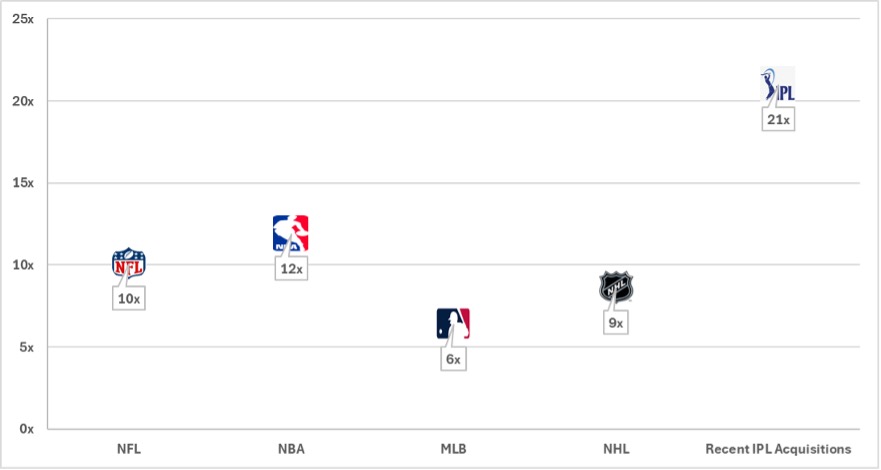
Second, these valuations imply price-to-revenue multiples in the range of 20x to 22x.[6] By comparison, S&P Global (the parent company of the S&P 500 index in the United States and a financial intelligence and analytics corporation) notes that price-to-revenue multiples for top-tier teams typically sit in the low double digits, with franchise valuations having accelerated sharply over the past decade, outpacing growth seen in prior periods.[7] Recent transactions illustrate the valuation levels being paid for established North American franchises. For example, the Milwaukee Bucks were sold at a price-to-revenue multiple of approximately 9.9x, while the Boston Celtics were valued at approximately 13.3x revenue in their recent transaction. [8] This valuation premium reflects the IPL’s positioning and growth potential compared to leading sports leagues such as the National Football League (NFL) and English Premier League (EPL).
Figure 1: Implied Average Revenue Multiples for North American Leagues vs Recent Acquisition of IPL Teams
In this article, the authors examine certain key factors underpinning the attractiveness of IPL franchises as an investable sports asset, including its adoption of advanced broadcast technology, premium media rights valuations, capital-light operating model, predictable profitability and, subject to potential cross-league regulation, the ability for investors to build multi-team portfolios across global cricket leagues.
This article looks at:
To continue reading or watching login or register here
Already a member? Sign in
Get access to all of the expert analysis and commentary at LawInSport including articles, webinars, conference videos and podcast transcripts. Find out more here.
- Tags: Board of Control for Cricket in India (BCCI) | Finance | Financial Regulation | India | Indian Premier League (IPL) | National Football League (NFL) | South Africa | United Kingdom (UK) | USA | Valuation | Women's Sport
Related Articles
- Decoding the Indian Premier League Media Rights Sale – Part 1
- How The Value Of European Football Clubs Compare To American Sports Teams
- Breaking the bank or building the game? The tightrope walk of Premier League football finance
- Valuing 'The Hundred': How will prospective investors evaluate cricket’s newest franchise?
- The price of fame: Examining discrepancies in football club valuations
- Acquiring women's football clubs: Key considerations for buyers & sellers
Written by

Steve Bainbridge

Shalabh Gupta
Shalabh Gupta is an Associate Director with Secretariat’s Damages and Forensic Investigations group based in Toronto. Shalabh has provided financial analyses, economic advisory, forensic accounting, quantification of damages and other litigation support services to clients and their counsel for over 10 years. He is a Chartered Accountant (CA), a Certified Fraud Examiner (CFE), and a Chartered Business Valuator (CBV).

Sarab Bhatia
Sarab is a Senior Associate who provides quantification of damages and other litigation support services to clients and their counsel. His experience spans business valuations and corporate tax advisory services over the last 9 years. Sarab is a CFA® Charterholder, a Chartered Accountant (CA) and a Chartered Business Valuator (CBV).

Ananyaa Ajay Kumar
Ananyaa Ajay Kumar serves as a paralegal within the Sports practice
Group at Greenberg Traurig's Dubai office.
She provides comprehensive support across a variety of sports regulatory, commercial, and compliance matters. Her work extends to the review and analysis of commercial sports contracts, conducting in-depth regulatory research, and assisting with issues affecting sports organisations, governing bodies, rights holders, and other industry players. Stakeholders across the evolving sports landscape.
Ananyaa Ajay Kumar completed her Master’s in International Sports Law at ISDE. Madrid, equipping her with specialised expertise in the intricate legal frameworks governing the sports industry.