Gameday for Football Agents: The road to Luxembourg and the ROGON judgment (Part 1)
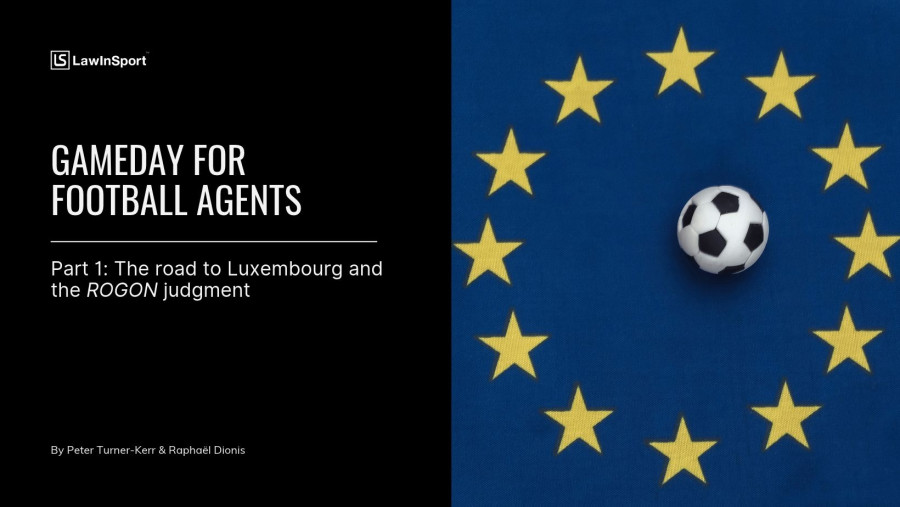
This[1] article is Part 1 of a series of four articles on the Court of Justice of the European Union’s (CJEU) recent rulings in the ROGON[2] (C-428/23) and RRC Sports[3] (C-209/23) cases and what they mean for the regulation of football agents and for sports governance more broadly. This Part 1 sets the scene: the two sporting federations involved and their rulebooks, the EU law framework for sport, and the Court’s judgment in ROGON.
Part 2 (see here) moves to RRC Sports, and takes up the ‘by-object’ analysis in that ruling as well as its consideration of the applicability of the Wouters/Meca-Medina exception and Article 101(3). Part 3 (see here) discusses the dominance, free movement and data protection elements of the RRC Sports ruling. Part 4 (see here) considers the key takeaways for sports governing bodies specifically, and, more generally, for other private regulators, professional associations and standard-setting bodies. It also discusses what is left for the referring national court to decide.
Article Outline:
- Introduction
- One match, two halves – how the regulation of football agents came before the CJEU
- ROGON and whether a federation can bind non-members
Note: The authors formed part of the team that represented FIFA in the RRC Sports case.
Introduction
Like December 2023, July 2026 will be remembered as an important month for sport in the EU, not only because the FIFA World Cup trophy returned to Europe, but also for the latest batch of judgments from the CJEU relating to the powers of sports governing bodies.
In a trilogy of judgments in December 2023, namely European Superleague[4], International Skating Union[5] and Royal Antwerp[6] (and in a further judgment in October 2024, Diarra[7]) concerning, amongst other things, the compatibility with EU law of rules regulating access to sport, the CJEU confirmed that it was legitimate to subject the organisation and conduct of international professional sporting competitions to common rules intended to guarantee the homogeneity and coordination of those competitions within an overall annual or seasonal calendar. It also confirmed that it was legitimate to ensure compliance with those common rules through provisions, such as those put in place by FIFA and UEFA, governing prior approval of such competitions and the participation of clubs and players therein.
However, the CJEU held that those rules must be subject to restrictions, obligations and review. Unconstrained powers granted to sports governing bodies can, by their very nature, be regarded as harmful to the proper functioning of normal competition and, therefore, constitute “by-object” restrictions of competition, or an abuse of a dominant position, contrary to the EU competition rules [Article 101 of the Treaty on the Functioning of the European Union (TFEU), which prohibits anti-competitive agreements; or Article 102 TFEU, which prohibits the abuse of a dominant position], or breach EU rules on free movement.
In assessing the compatibility of sporting rules with EU law, the CJEU confirmed in those judgments that legitimate sporting objectives are relevant and can inform that assessment. The doctrine developed by the CJEU in the Wouters/Meca-Medina case law[8] may take restrictions resulting from sporting rules outside the scope of Articles 101 or 102, provided that they are not deemed to be restrictive by object.
On 9 July 2026, the CJEU delivered its judgment in ROGON GmbH & Co. KG and Others v Deutscher Fußball-Bund eV (DFB), which concerned the compatibility with Article 101 of German football federation rules regulating the use by clubs and players of football agents.[9]
That judgment was followed, on 16 July 2026, by the CJEU’s ruling in FT and RRC Sports v Fédération Internationale de Football Association (FIFA).[10] This ruling addressed the compatibility with EU law, in particular the EU competition rules, of FIFA’s new regulatory framework for football agents, introduced in early 2023: the FIFA Football Agent Regulations (FFAR).[11]
These judgments consider the scope of the powers of sporting federations and, in particular, whether they extend beyond their own members. ROGON and RRC Sports can be read as two halves of a single match. ROGON settles certain questions of principle: whether rules adopted by a football federation governing the activities of third parties (such as football agents) can fall outside EU competition rules by virtue of the Wouters/Meca-Medina case law; and whether a set of rules should be assessed under that case law as a whole or considered rule-by-rule. RRC Sports applies the ROGON framework to a specific set of rules governing third parties: the FFAR.
If the December 2023 trilogy plus Diarra were read by some as signalling a narrowing of the scope for sports federations to regulate their sports, ROGON and RRC Sports suggest, in the authors’ view, that such a reading was overly pessimistic. ROGON confirms that the competence of sports federations to regulate their sport goes beyond their own members and can include rules that affect the activities of non-member third-party undertakings linked to the sporting ecosystem they govern, in this case football agents. RRC Sports confirms that the majority of the specific rules adopted by FIFA to regulate the activities of football agents in the football transfer system do not restrict competition by object, and, to the extent that they have restrictive effects, can in principle be justified (including caps on the fees that football agents can charge their clients).
To continue reading or watching login or register here
Already a member? Sign in
Get access to all of the expert analysis and commentary at LawInSport including articles, webinars, conference videos and podcast transcripts. Find out more here.
- Tags: Antitrust_Competition & EU | Court of Justice of European Union | European Union | FIFA | FIFA Football Agent Regulations | Football | Treaty of Functioning of the European Union (TFEU)
Related Articles
- A Guide to the new FIFA Agent Regulations For Football Agents & Clubs
- The Global Trend Of Action Against No-Poach And Wage-Fixing Agreements In Sport
- UEFA Home-Grown Player Rule EU Law Challenge – Royal Antwerp FC V Royal Belgian FA
- Understanding FIFA’s Agents’ Regulations - Experts’ Discussion
- Working as a football agent in Italy: Complying with the FIFA's Football Agent Regulations & Italian law
- Football agents (PROFAA) v FIFA – CAS’s biggest EU competition law decision yet?
- The end of the FIFA Agents Cap and the beginning of a less restrained standard of competition review in sport?
- Regulating the Regulators: Competition Law Takes on FIFA’s Agent Rules
- Indefinite provisional suspensions and competence under the FFAR: CAS Panel reinstates suspended agent licence in Tullio Tinti v FIFA
- When Safety Rules Collide with Competition Law - The UCI Gear Ratio Decision
- Sport & Competition Law – Annual Review 2025/26
- Beyond the Super League: How the Madrid Ruling and Competition Law Are Reshaping Sports Governance
- When Is a No-Poach Agreement a ‘By-Object’ Restriction? Lessons from Tondela (Part 1)
- Can a No-Poach Agreement Be Justified? The Legitimate-Objective Route in Tondela (Part 2)
- When can sports federations sanction club directors? Review of CJEU ruling - Part 1
- When is a sports body a “court or tribunal” under EU law? Review of CJEU ruling - Part 2
Written by

Peter Turner-Kerr
Peter Turner-Kerr joined the firm in 2019 from the Australian Competition and Consumer Commission (ACCC), where he was a Director in the Merger Investigations Branch and led a number of significant merger reviews, including, for example, the Siemens-Alstom and Tronox-Cristal transactions.